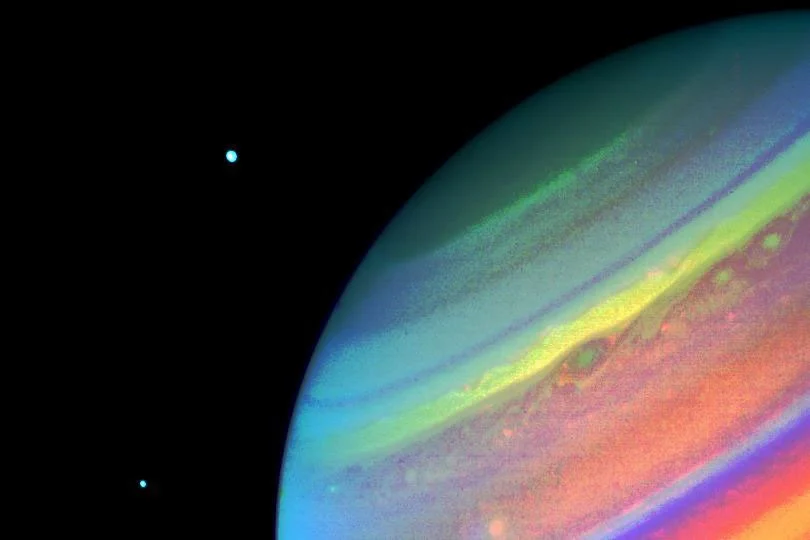
Colour-processed view of Saturn from Voyager 2 images taken on August 11, 1981. NASA/JPL-Caltech
Read the storyThe cameras were meant to follow the rings and moons. During the encounter their platform stopped turning in one direction.
What Voyager managed to see
In August 1981 Voyager 2 studied Saturn’s atmosphere, rings and moons. It returned more detailed views of several moons and helped trace the fine structure that Voyager 1 had seen in the rings.
Source · NASAWhy the cameras pointed the wrong way
After closest approach, an actuator on the platform carrying the cameras and some spectrometers seized. Some observations were lost. Engineers studied the mechanism on Earth, restored the platform to service and limited the pointing manoeuvres that could cause trouble on later encounters.
Source · NASAHow the first flyby shaped the second
The science team added many observations after seeing the Voyager 1 images. In JPL’s retrospective, team members describe how this increased the demands on the moving platform. After Saturn, the planet’s gravity sent Voyager 2 onward to Uranus.
Source · JPL