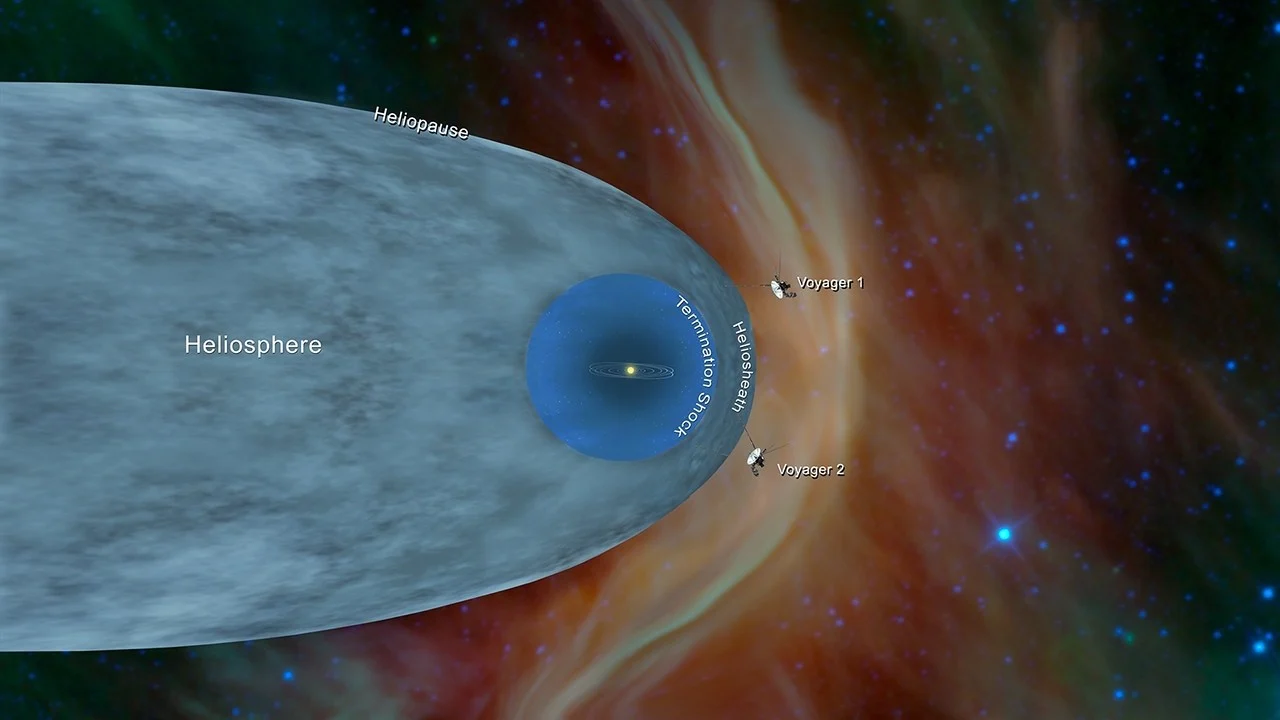
NASA/JPL-Caltech illustration of the heliosphere and both Voyager spacecraft. NASA/JPL-Caltech
Read the storyVoyager 2 crossed the heliopause with a working instrument that could measure the plasma flow directly.
How the instruments caught the crossing
On November 5, 2018 the plasma instrument recorded a sharp drop in solar-wind particles. Other detectors saw fewer particles associated with the Sun and more galactic cosmic rays. Together the independent measurements marked the crossing of the heliopause.
Source · JPLWhat the second route added
Voyager 2 crossed about 119 astronomical units from the Sun, in a different direction from Voyager 1. Its working plasma instrument captured the transition directly. For Voyager 1, researchers inferred interstellar plasma density from its oscillations.
Source · NASAWhat the crossing means
Beyond the heliopause the probes measure the medium between the stars. The Sun’s gravity still acts there. The probable outer reaches of the Oort Cloud lie much farther from the Sun than the boundary of the solar wind.
Source · NASA