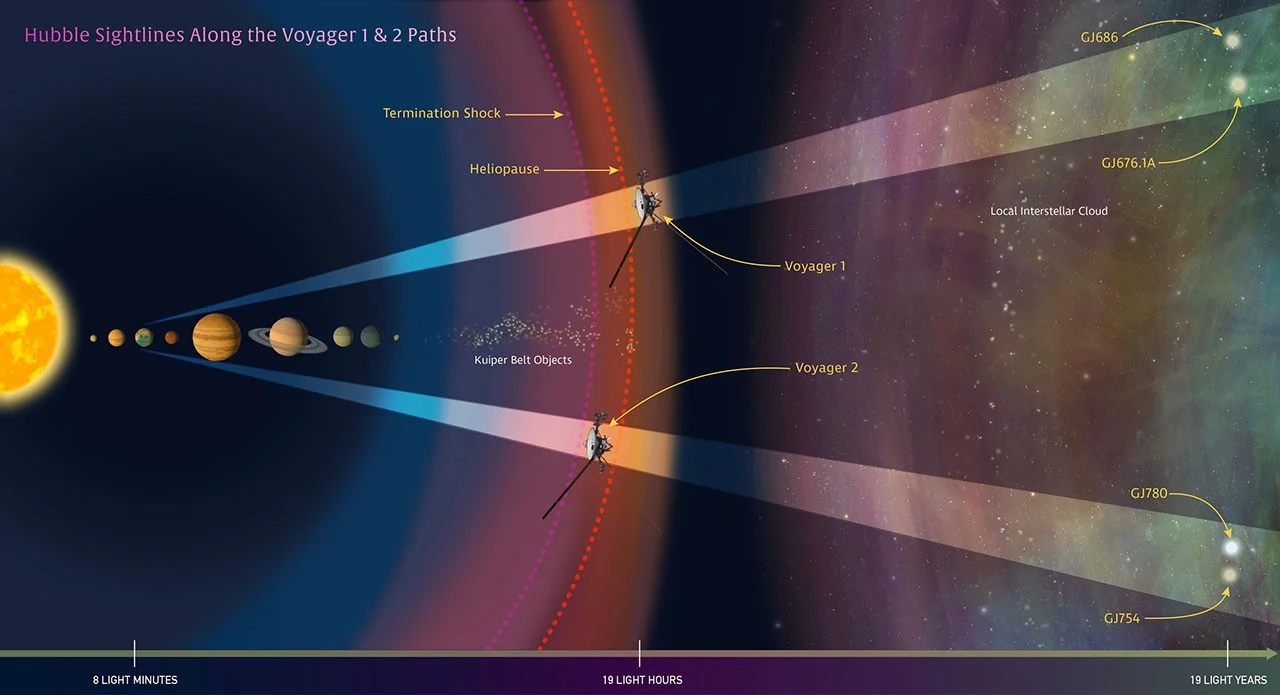
NASA and ESA illustration of Hubble looking along both Voyager trajectories. NASA, ESA, Z. Levay (STScI)
Read the storyIn the far future Voyager 2 will pass the red dwarf Ross 248. The forecast counts years from the study’s epoch.
What NASA reports
NASA’s FAQ says Voyager 2 will pass within about 1.7 light-years of Ross 248 in roughly 40,000 years. The small star is in the direction of Andromeda. The figure describes the moment when spacecraft and star are closest.
Source · NASAWhere 42,000 years comes from
Coryn Bailer-Jones and Davide Farnocchia combined Gaia DR2 measurements with JPL trajectories. Their calculation gives about 42,000 years to the encounter and a closest distance of roughly 0.529 parsecs, or 1.73 light-years. The timeline uses that estimate of the interval.
Source · Bailer-Jones & FarnocchiaWhy the star’s motion matters
Stars move relative to the Sun. To find when a spacecraft will pass a star, researchers trace both motions. The same study predicts an earlier encounter with Proxima Centauri, at a larger distance.
Source · Bailer-Jones & Farnocchia