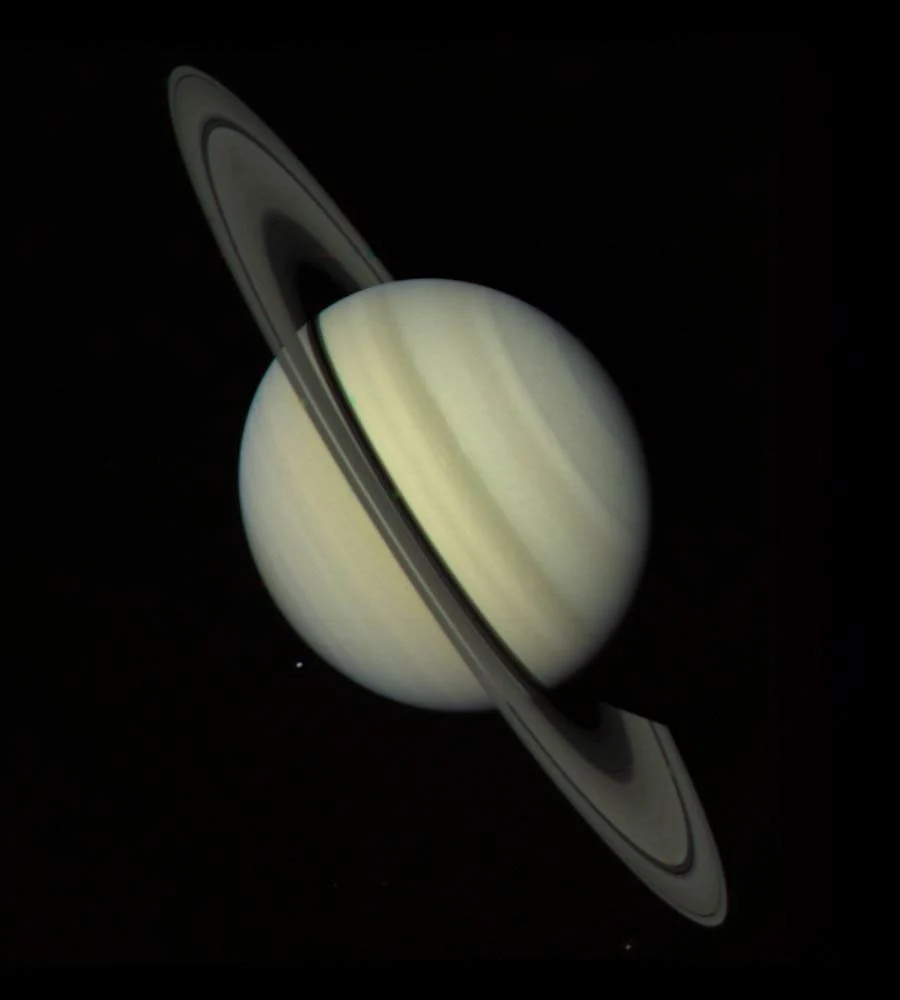
Saturn and the shadows of its rings, imaged by Voyager 1 on October 18, 1980. NASA/JPL-Caltech
Read the storyVoyager 1 took a route that brought it close to Titan and sent it north of the planets’ orbital plane after Saturn.
How Titan’s atmosphere was measured
The cameras saw a thick haze hiding the surface. As the radio signal passed through Titan’s atmosphere, it changed. The team used those changes to estimate surface pressure. Instrument readings showed that nitrogen dominated the atmosphere.
Source · NASASaturn in close-up
On November 12, 1980, the spacecraft passed about 126,000 kilometres above Saturn’s clouds. Its images revealed narrow rings and gaps in far more detail than Earth-based observations. Small moons on either side of the F ring helped explain how it keeps its shape.
Source · NASAWhat the route made possible
Titan was a central scientific priority. The geometry of the encounter with the Saturn system sent Voyager 1 out above the orbital plane. The route to Uranus and Neptune remained open to its twin.
Source · JPL