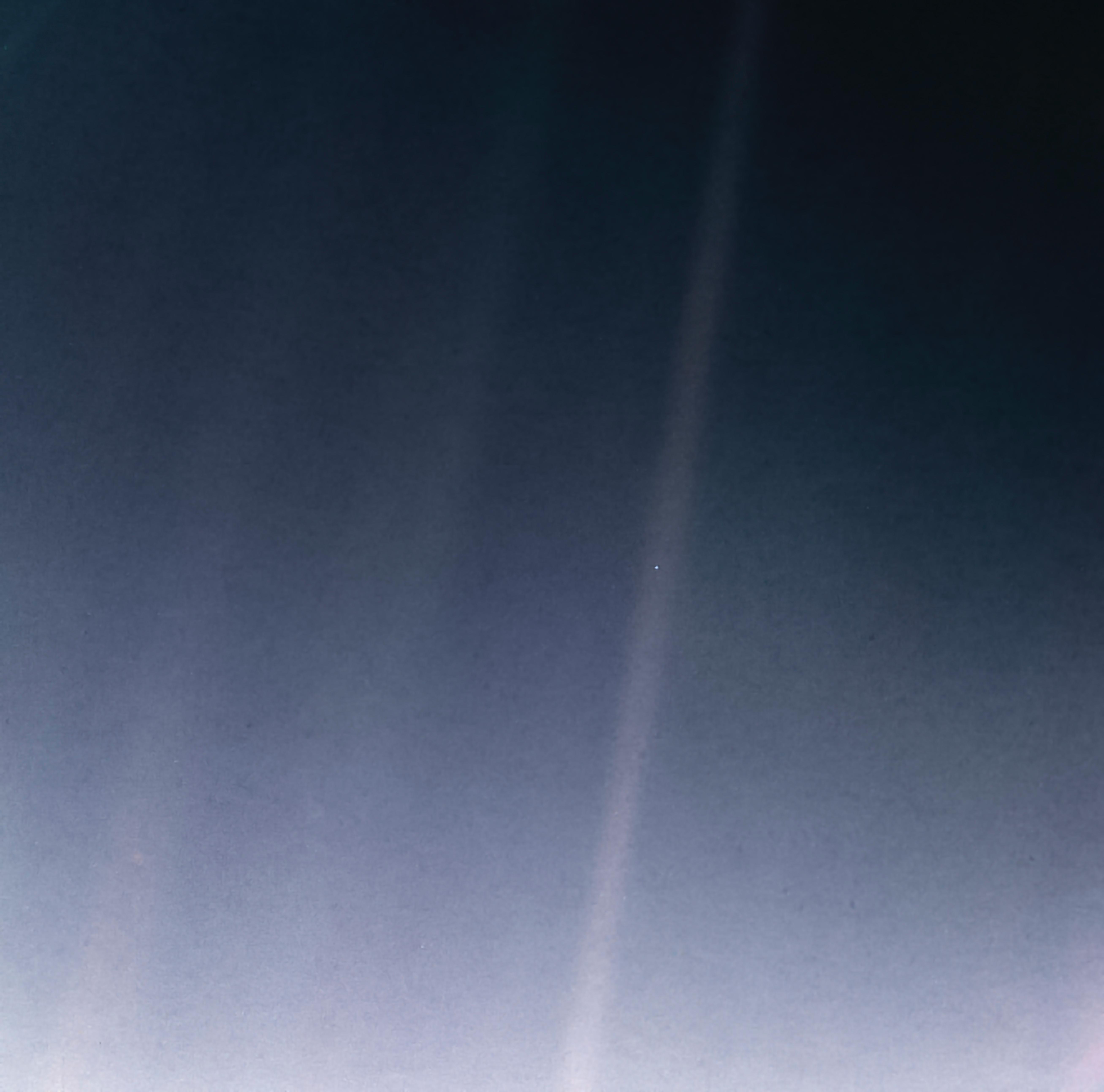
Earth in a band of scattered light. NASA/JPL-Caltech’s 2020 reprocessing. NASA/JPL-Caltech
Read the storyBefore its cameras were switched off, Voyager 1 looked back at the planets. In one of 60 frames Earth took up about a tenth of a pixel.
One last look at the planets
On February 14, 1990, Voyager 1 was beyond Neptune’s orbit. About 6.4 billion kilometres from Earth, its narrow-angle camera imaged the planet’s tiny disc. Other frames captured Venus, Jupiter, Saturn, Uranus and Neptune. Together they formed the Solar System Family Portrait.
Source · NASAWhere the bright band came from
The Sun lay close to the camera’s line of sight. Light scattered inside the optics produced bands, one of which crossed Earth. In 2020 a JPL team reprocessed the original frames with modern tools while preserving their content.
Source · NASAWhen the public first saw it
At the June 6, 1990 press conference, project scientist Ed Stone presented the mission’s results and Carl Sagan pointed to the barely visible speck that was Earth. NASA has released the archived briefing. A few years later the image gave Sagan’s book its title.
Source · NASA