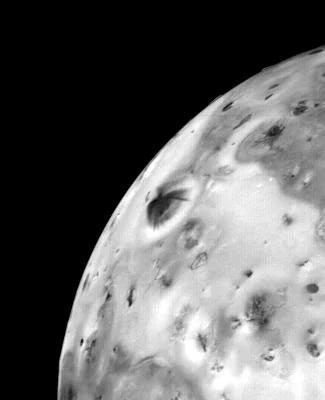
Voyager 1 imaged this eruption near the edge of Io on March 4, 1979. NASA/JPL-Caltech
Read the storyJupiter turned out to have a faint ring and more moons. The biggest surprise appeared in the images of Io.
A close look at Jupiter
Closest approach came on March 5, 1979. New images showed the cloud flows around the Great Red Spot. An image taken with a specially planned camera pointing revealed Jupiter’s faint ring.
Source · NASAWhat Linda Morabito spotted
Optical navigation engineer Linda Morabito was processing an image of Io to help pin down the spacecraft’s position. She noticed a feature jutting beyond the edge of the moon. It turned out to be a volcanic plume. Morabito later described how the team checked what could have produced it.
Source · Linda MorabitoWhy it mattered
Before then active eruptions had only been observed on Earth. Io showed that a moon-sized world could also be volcanically active. Gravitational interactions with Jupiter and its other large moons flex Io and heat its interior.
Source · NASA