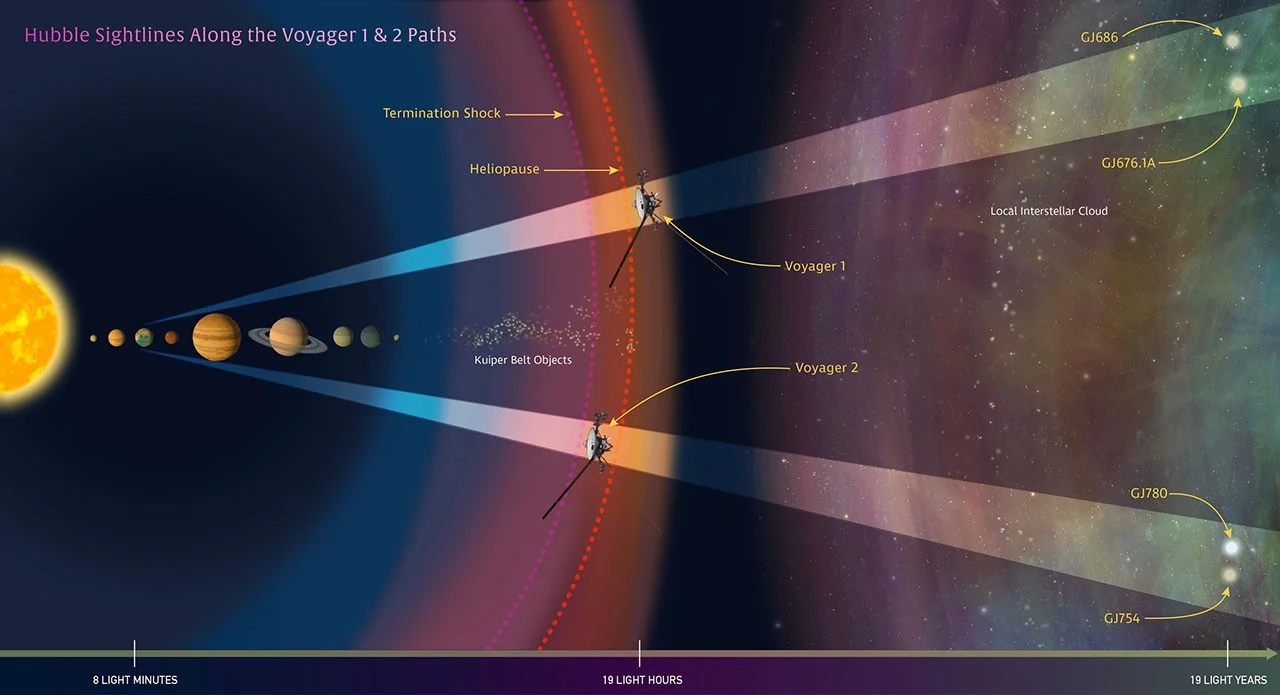
NASA and ESA illustration of Hubble looking along the two spacecraft’s paths. NASA, ESA, Z. Levay (STScI)
Read the storyThe faint red dwarf is moving through the Galaxy too. The closest point depends on the routes of both star and spacecraft.
Where the year 40,272 comes from
NASA’s FAQ lists the year 40,272 and a closest distance of 1.7 light-years for Gliese 445, also known as AC+79 3888. That is a calendar year. The minimum distance is between the star and the spacecraft at their future positions.
Source · NASAWhy estimates differ
In Coryn Bailer-Jones and Davide Farnocchia’s calculation using Gaia DR2, the pass by Gliese 445 occurs about 44,000 years from the study’s epoch, at roughly 1.88 light-years. That is a separate estimate based on measured stellar motions and the spacecraft’s modelled path.
Source · Bailer-Jones & FarnocchiaHow close that really is
Even at closest approach, trillions of kilometres will separate them. The study authors’ map shows other stars Voyager 1 may pass as well. Each encounter has its own predicted date and distance.
Source · Bailer-Jones & Farnocchia